Who Has Power in the PR Industry?
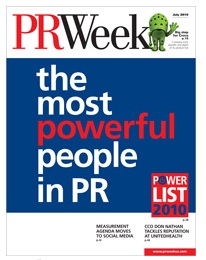
In July, PR Week published its annual PR Power List, recognizing the public relations and corporate communications professionals its staff deems the 25 most powerful in the industry. These are “people who make things happen, demonstrate vitality and enthusiasm for what they do, and have an influence beyond their circle.”
PR Power List & Social Media
In 2008, we were a bit surprised that none of the Power List influentials were on Twitter. Two years later, now that Twitter has reached mainstream success, we decided to take another look.*
Less than half of the members of the PR Power List have a Twitter account. Of these 12:
- Five have never posted a status update. Four of those don’t have a photo for their account. Three don’t have bios.
- One protects his tweets.
- Four tweet on occasion, approximately once per week. However, most information shared is self-promotional (personally or for the company).
- Note: There may have been a 13th Power List member on Twitter, but we were unable to confirm since the account doesn’t have a photo or bio, and was only updated three times.
In the end, we found only two members of the PR Power List that have Twitter accounts and use them effectively — meaning that they share interesting, relevant information and engage with their followers.
In addition, only:
- Fifteen of the PR Power List members have LinkedIn profiles. One links to his blog on his LinkedIn profile.
- Seven have Facebook profiles that appear in Google searches.
- Five blog, either for their company or on a personal blog.
I’m not trying to argue about the validity of the PR Power List. Clearly, these people are quite powerful. They help run million- and billion- dollar businesses, and make decisions that affect thousands of employees and consumers. And, I’m sure they are very busy folks — arguably, too busy for social media.
The Influence of Social Media on PR
That being said, social media is becoming an essential part of strategic public relations, and it’s likely this trend will only continue in the future.
If the leaders of our industry are not listening to their peers, consumers, employees and other influencers — and sharing their vision with those who are actively shaping the future of the business — how much longer can they stay relevant?
Currently, there are more than 4,000 Twitter users that have tagged themselves on WeFollow.com with “PublicRelations,” and more than 3,500 tagged with “PR.” Top PR tweeters such as Steve Rubel, Kevin Dugan, Deirdre Breakenridge, Sarah Evans, and Brian Solis have thousands of followers, and are sharing information and engaging with followers daily.
As an integral part of their career and professional growth, these people — and many others in the industry — are:
- Blogging,
- Sharing articles,
- Exchanging ideas,
- Training emerging professionals,
- Hosting and participating in Twitter chats,
- Managing and joining conversations in LinkedIn Groups, and
- Talking with one another about our industry and its future.
In many ways, these people are shaping the future of public relations. And, the industry’s 25 most powerful are largely absent from these discussions.
Your Thoughts?
What do you think it means to be powerful in business today? Does it matter if executives are present in social media? You be the judge: Who really has the power in the PR industry?
I’d love to hear your thoughts on this. Please leave them in the comments below.
Related Posts:
- PR Industry's Worst Enemy: The Irrelevant Aristocracy
- Top PR Firms Fail to Make the Grade Online
- 10 Traits of an Emerging PR Pro
- PR Week Power 25 Nowhere to be Found on Twitter
Laurel Miltner is a consultant at PR 20/20, a Cleveland-based inbound marketing agency and PR firm. Follow Laurel on Twitter @laurelmackenzie, or connect on Facebook at Facebook.com/laurelmiltner.
Stay updated: Subscribe to the PR 20/20 blog, check us out on Facebook or follow the team on Twitter.
*In July and August 2010, we conducted name searches on Google, Twitter, LinkedIn and Facebook of the winners. If you think we missed you, please let us know below in the comments or connect with us on Twitter @pr2020.


Comments
Byron Fernandez
| Permalink
Albert Maruggi
| Permalink
Why? they have money to make. Now the cynic in me wants to ask the question of those not using Twitter, how much are they billing clients and producing content for them that is for Twitter? No one will cover that story because cynics don't get invited to parties, or RTed etc. Nice piece
you ask who has power. I can't remember where I heard this but I'll use it for the answer. Power is described this way. Shaq has money, those that sign Shaq's check have power.
Kevin Dugan
| Permalink
It's less than financially viable to say the least if a CEO is stuffing envelopes or making copies...they should be focused on big picture, brain intensive work. You can argue the same applies to social media. Do they need to understand it? Yes. Do they need to participate? It depends on what the company is trying to achieve.
Can they pull it off? They already multi-task using their smart phones I am willing to bet. This could be layered in assuming they are already Blackberry Ninjas.
But as the social media space continues to evolve, we need better ways of separating the professional wheat from the expert chaff. A CEO's personal participation across social media could, in some instances, be a metric. But I don't think it's a viable long term standard for determining a firm's social media muster.
IMHO, the bigger sign that a CEO understands social media is when they help foster it internally -- encouraging a cross-departmental approach involving as many areas as IT, legal, HR, customer service and, yes, marketing/PR. From there the CEO needs to support this team in their efforts to establish and maintain a social media presence while training employees about what to do and what not to do....a social media policy is nothing without training.
The above is a big ask much less getting them to tweet. And yes, my above scenario applies more to our clients than the agencies you discuss above. Just another facet of a great topic of conversation.
Thanks for singling me out in the above examples. Cheers.
Laurel Miltner
| Permalink
Kevin, you make some excellent points. I absolutely understand the argument that execs are busy, their time is valuable, and they may not personally need to be active in social media in order to understand and encourage it within their organization.
However, I also think that social media is such a transformation in the way we communicate and do business, I might argue that one can't truly understand the medium and community expectations without being in it. I suppose my concern lies in the fact that our industry's reputation is at stake if professionals are recommending strategies they don't really comprehend.
Not to mention, those like yourself who are heavily involved are strongly influencing the future of public relations and how social melds with traditional practices. Perhaps power and influence aren't synonymous, but I do think influence is an integral part of being powerful â and professionals absent from social discussions are missing out on this.
Thanks for stopping by.
Jacquie
| Permalink
Jim Weiss
| Permalink
My view is that the firmâs collective investment in and contribution to the online world Is what matters most though I have personally come a long way over the past 12 - 18 months and keep learning and doing more with social media every day.
Iâm also pleased that www.wcgworld.comâs ranking has gone to 128,212 in the United States and 322,148 in the world -- and climbing -- by Alexa.com when our rank the year before was exponentially lower and the fact that we now have nearly 20 people blogging externally.
We also have a thriving Yammer community internally where we share ideas all day in real time.
Weâre continually learning with our clients via our educational podcast series and through more direct 1:1 next practice sharing. Youâll see a lot more from us in the future so stay tuned.
Beverly Dracos
| Permalink
For those of us who have had, do have, and will always have a focus on relationships, social media and all its platforms are just another way of connecting and therefore, a logical extension. The dynamic is changing. It is undeniable. Dive in now or slowly wade in later...either way, the social media waters are fine for PR.
Laurel Miltner
| Permalink
I absolutely agree with you that social media isn't just about being active on Twitter. We simply used Twitter to provide some insight, largely because it is a social network through which we (PR 20/20) have found a lot of value due to its strong PR & marketing community.
You definitely hit the nail on the head though, that the beginning of any social strategy should be finding where your target audiences are active.
Jim,
Thanks for stopping by, and for sharing some of the details about how you're integrating social strategies at WCG. I certainly agree that the collective effort from the team is much more important than that of one individual. Looking forward to seeing what the future holds! And, congratulations on making the 2010 PR Power List!
Leave a Comment